The quick answer
Money in the bank does not, by itself, prove that a dental practice is profitable. Review accurate monthly financial statements, including a profit-and-loss statement and a balance sheet, alongside production and collections reports. Laura Phillips, E.A., recommends understanding cash and profit separately and asking a qualified accounting professional to explain what the numbers mean for your practice.
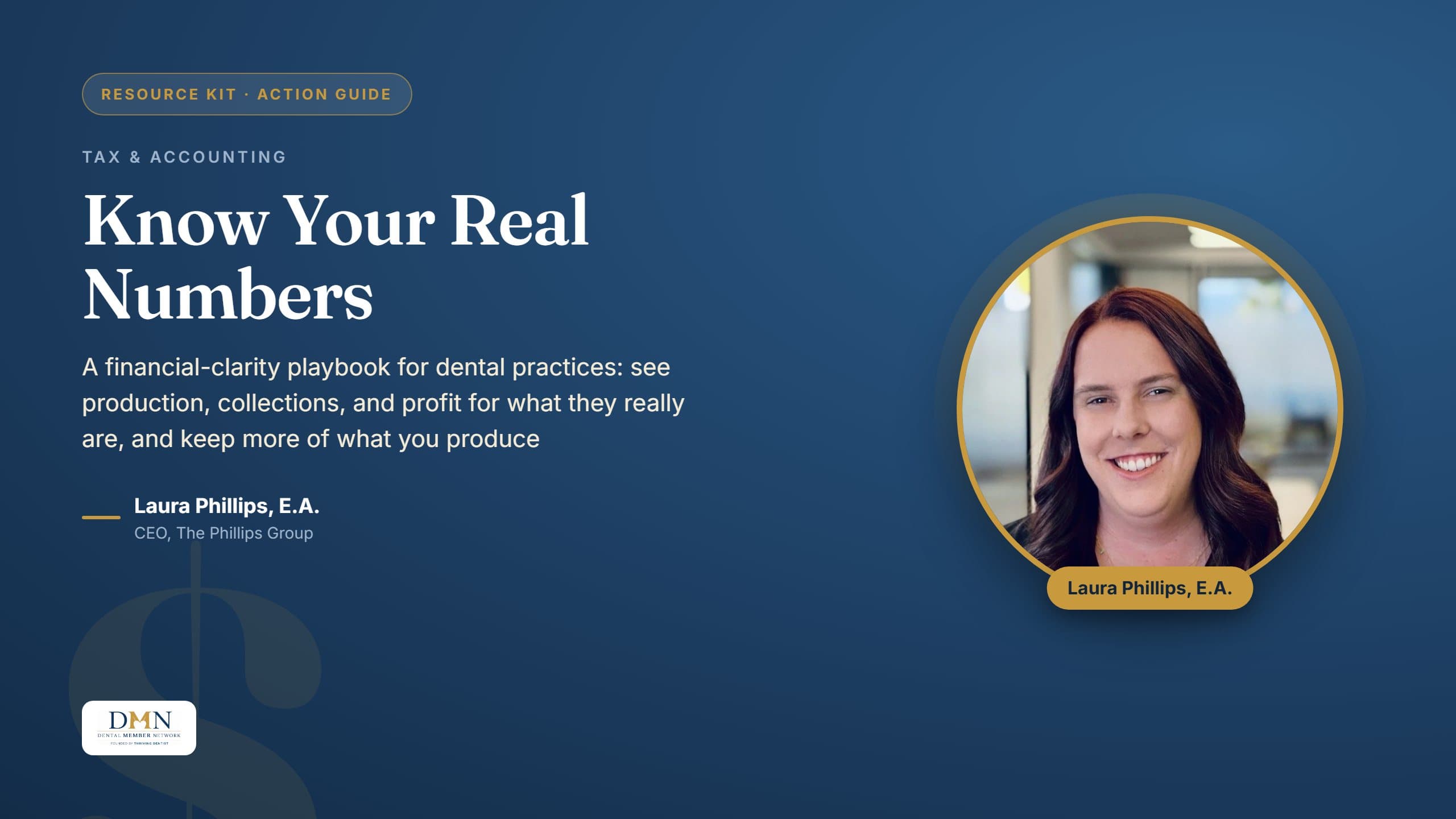
Expert guidance from Laura Phillips, E.A., based on the DMN Practice Playbook, Know Your Real Numbers.
The bank balance answers an immediate question: how much cash is there?
It does not answer every question behind it. What does the practice owe? Is the money coming from profitable operations? Are expenses rising faster than the work being produced?
Separate production, collections, profit and cash
These terms often appear in the same conversation, but they are not interchangeable.
- Production describes the value of work recorded in the practice-management system. Ask which adjustments are included in the report you use.
- Collections describes money received. Payments may relate to care provided in an earlier period.
- Profit is the result shown after relevant income and expenses are accounted for under the basis used in your books.
- Cash is the money available at a point in time, which can also be affected by borrowing, repayments and other movements.
These are general explanations, not a substitute for interpreting your own accounts with your advisor.
Laura's central message is that activity can hide the underlying picture. More appointments or higher production does not automatically mean more profit.
Our article on why new-patient growth can hide a weak case-acceptance system examines another version of that problem: measuring activity without checking what happens next.
Read the profit-and-loss statement and balance sheet together
Laura's Playbook asks owners to use both statements, rather than relying on a bank balance or a once-a-year tax conversation.
The profit-and-loss statement helps you examine performance over a period. The balance sheet helps you understand the financial position at a particular date, including assets and liabilities. The SEC's plain-language guide to financial statements explains these distinctions in more detail.
Ask your accountant to walk you through any gap between the profit shown and the cash you expected to have. The difference may have an explanation, but you need to understand it before making decisions.
Do not assume that a positive bank balance means every upcoming obligation is covered. Equally, do not assume that a tight cash position proves the practice has no profit.
Make the monthly numbers comparable
Laura recommends looking at collections and major expenses as percentages of production.
When using that approach, confirm the definitions first. Are you using gross or adjusted production? Are the dates consistent? Does the comparison help answer the question you are asking?
A collection figure from one period may include payments for earlier treatment. That is why a single month's ratio needs context.
Keep the basis consistent when comparing your own results over time. If an outside benchmark uses collections rather than production as its denominator, it is not the same ratio and should not be treated as a direct comparison.
The useful conversation is not just whether a number went up. It is why it changed and whether the change deserves attention.
Ask what is behind a busier practice
Suppose production rises while profit does not improve. That is a reason to investigate, not a reason to jump immediately to cutting staff or changing fees.
Laura's Playbook encourages owners to review the other side of the ledger: costs, collections and whether the services or arrangements in place still make financial sense.
Bring a specific question to your advisor. Which expense changed? Is it a timing issue? Is it recurring? Is the report complete and accurate?
If collections are part of the concern, our guide to preventing dental insurance claim denials covers the operational process behind one possible source of delay.
Turn a report into one clear next step
A useful monthly review can finish with three simple notes:
- What changed?
- What explanation still needs checking?
- Who will check it, and when will you review the answer?
This is an editorial way to apply Laura's emphasis on regular financial clarity. It is not a new accounting standard or a promise that one review will improve profit.
Her Financial-Clarity Worksheet brings production, collections, expenses, bank cash, reported profit and liabilities into the same review. It also asks which number you will start tracking each month.
The value is in connecting the figures to a question you can act on.
Frequently asked questions
Can a dental practice have cash in the bank without being profitable?
Yes. Cash and profit measure different things. Borrowing and the timing of money coming in or going out can affect cash, so the balance alone is not a profitability test.
Which financial reports should a dental practice owner review?
Laura recommends accurate monthly financials, including the profit-and-loss statement and balance sheet, together with an understanding of production and collections. Ask your accounting professional which additional reports your situation needs.
Should I compare expenses with production or collections?
Laura's Playbook uses production for its review. Other reports may use collections. Confirm the definition and use a consistent basis; ratios with different denominators are not directly interchangeable.
The takeaway
Know what your numbers are telling you.
Cash and profit answer different questions. Read the profit-and-loss statement and balance sheet together, keep production and collections comparisons on a consistent basis, and finish each monthly review with one question your advisor can help you answer. This article provides general business education, not personalized accounting, tax or financial advice. Review decisions with a qualified professional who understands your practice.
Tax & Accounting
Know Your Real Numbers

Laura Phillips, E.A.
The Phillips Group, Tax & Accounting
Continue inside the membership
Get the complete Know Your Real Numbers Practice Playbook.
Available inside Dental Member Network, including the Financial-Clarity Worksheet. Use it to prepare clearer questions for the professional who helps you manage the practice's accounts.
Join Dental Member Network