The quick answer
To train a new dental team member, explain the task and expected standard, demonstrate how your practice does it, and give the person a safe opportunity to practise. Check their understanding through an observed example, provide feedback, and agree on the next step before assuming they can work independently.
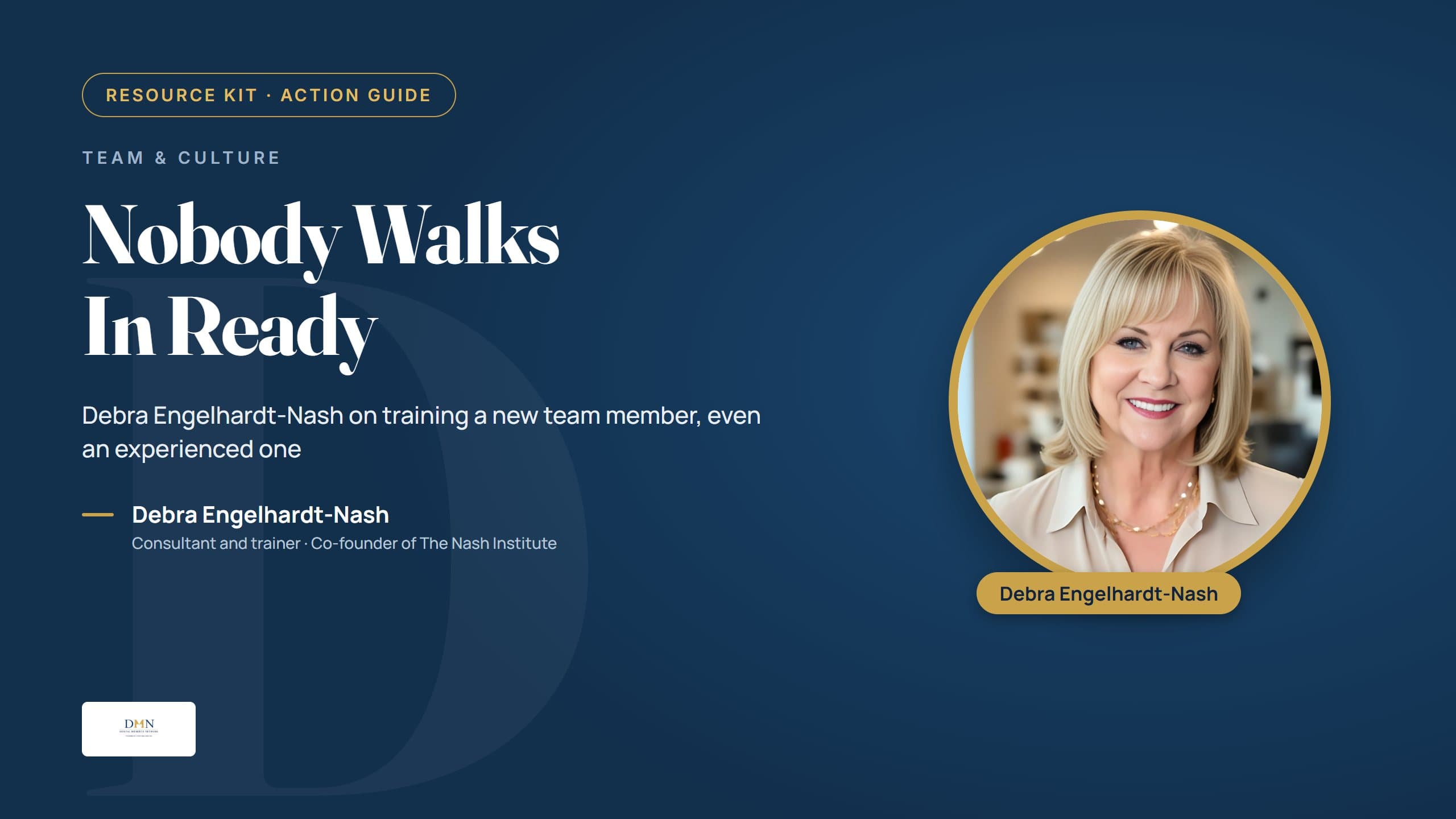
Expert guidance from Debra Engelhardt-Nash, consultant, trainer and co-founder of The Nash Institute, adapted from Nobody Walks In Ready.
Debra Engelhardt-Nash's central point is that experience does not replace training. Someone can bring valuable skills from another practice and still need to learn your workflow, handoffs and expectations.
Start with what is different in your practice
A new employee may know the software but not your process for recording a callback. They may have handled patient questions for years but not know when your practice expects a question to go to the dentist.
That does not automatically make them a weak hire. It identifies the work your onboarding needs to do.
Debra recommends a written training protocol rather than expecting someone to arrive ready for every part of the role. Start with a specific task, the person teaching it, and what satisfactory performance looks like.
If you are still choosing whom to hire, hiring dental staff when you are short-staffed addresses the earlier decision. This article starts after that decision, when the practice needs to help the new person succeed.
Tell them, show them, then let them practise
Debra's practical sequence has three parts.
Tell: Explain what the person needs to learn and why it matters.
Show: Demonstrate the task or conversation, including the details that an experienced team member may otherwise leave unspoken.
Practise: Let the learner try it in a supported setting before the same situation arrives during a busy patient day.
Watching a video or hearing an explanation can be part of training. It is not the same as demonstrating the skill.
Debra puts the distinction plainly:
“If you never practice, never assume that they get it.”
Debra Engelhardt-Nash
Rehearse one patient conversation
Debra uses patient questions about cost and insurance as examples of conversations worth rehearsing. The aim is to help team members respond thoughtfully, not teach them to make promises they cannot support.
Here is an illustrative exercise applying her method, not a transcript from her Playbook.
Situation: A patient asks why an estimate differs from what they expected.
Explain the standard: Listen, identify what the patient wants clarified, and involve the appropriate team member rather than guessing about benefits or clinical recommendations.
Demonstrate: An experienced colleague shows how to acknowledge the concern, locate the information available and explain the next step.
Practise: The new team member responds while a colleague plays the patient. Swap roles so the learner can hear how the explanation feels from the other side.
Review: Was the response clear? Did the learner avoid unsupported promises? Did they know when and how to ask for help?
Use fictional examples for rehearsal and the practice's approved procedures for real situations. Clinical advice and payer-specific decisions require the appropriate professional input.
Make progress visible without turning training into a test of confidence
A confident answer is not always an accurate one. A hesitant learner may understand the task but need more practice.
As an editorial tool for applying Debra's framework, use a short task record:
- Task being learned.
- Person providing the demonstration.
- Expected standard.
- Practice opportunity completed.
- What the learner can do and where support is still needed.
- Next review.
This is a suggested training record, not a fixed timetable or certification. Different roles and tasks require different levels of supervision. Do not use one successful rehearsal to authorize work beyond the person's responsibilities or qualifications.
Put training time in the diary
Debra emphasizes scheduling training and holding one-to-one conversations about expectations and growth. If training is always postponed until the practice is quiet, it may never receive focused attention.
Protect time for practice, questions and feedback. Ask which part remains unclear and what support the person needs next.
The leader has a part in this too. If different experienced team members demonstrate conflicting methods, agree on the practice's standard before asking the new employee to follow it consistently.
For the wider team habits that make expectations clearer, see how to improve communication in your dental practice.
The first question to ask this week
Choose one task a new team member is expected to perform. Has somebody explained it, demonstrated it and watched them practise it?
If not, that is a concrete place to begin. Training becomes more useful when the next step is visible to both the learner and the person supporting them.
The takeaway
Experience does not replace training.
Explain the task and the standard, demonstrate it the way your practice does it, and let the new person practise before it happens with a real patient. Record what they can do and what still needs support, and protect the time to do it.
Team & Culture
Nobody Walks In Ready
Debra Engelhardt-Nash
Consultant and trainer, co-founder of The Nash Institute
Continue inside the membership
Get the complete Nobody Walks In Ready Practice Playbook.
Available inside Dental Member Network, including The Training Protocol Worksheet.
Get the complete Nobody Walks In Ready Practice Playbook inside Dental Member Network, including The Training Protocol Worksheet.
Join Dental Member Network