The quick answer
To have a difficult conversation with a dental employee, go in knowing what success looks like: the team member leaves clear on what is expected, clear on what is at stake, and clear on the next steps. Julie Parker, co-founder of Dental Business Mastery, calls putting it off the nice choice and having it the kind one. In her words, kind "would have been telling them exactly what was at stake."
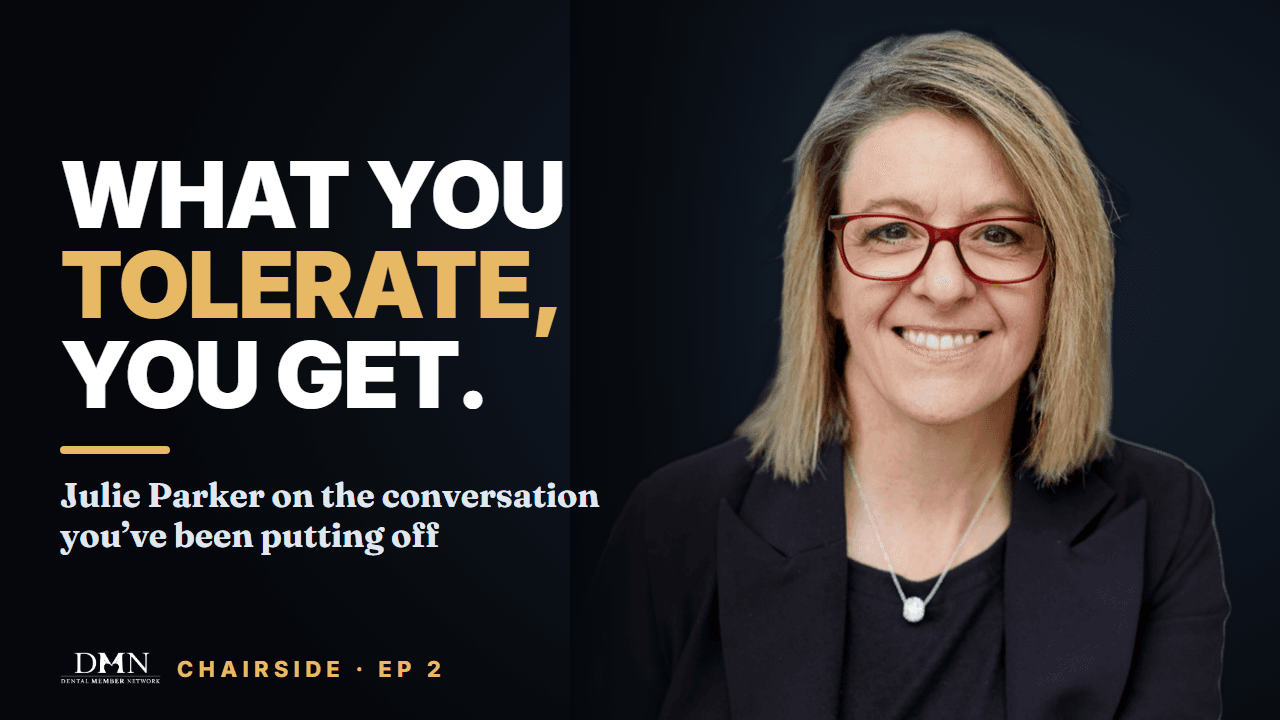
Julie Parker started as a dental assistant and went on to own a practice in Australia for ten years before she became a practice management consultant.
Early on, she says, the business books she read taught her one thing about leading a team: "If I was going to go down this path of being the nicest boss I could be to the people that work for me, it was going to hinder my success, and it was going to make life hard for them as well."
What is the difference between being nice and being kind?
Nice protects how everyone feels in the moment. Kind protects the person's future, and the team's.
Julie tells the story of a manager who kept having gentle conversations with a team member whose work was slipping. Then the manager's own boss stepped in and let the employee go. Only then did the manager see that she had been nice when she needed to be kind. In Julie's words, "Kind would have been having a more difficult, confronting, potentially upsetting conversation."
She ties this to psychological safety. The part owners miss, she says, is that the team expects you to protect the practice's standards. "A psychologically safe working environment means that we are addressing that problem as early as possible."
What happens when an owner keeps choosing nice?
Julie describes a practice she has worked with for a long time. The owner is a very nice person and a good businessman who wanted his team well looked after. When team members had children, he let them come back two days a week. When another needed to leave by three every day, he said yes to that too.
Each yes made sense on its own. Twelve years later, the team was fracturing. Others were carrying the load, and gaps opened in the systems. Julie's summary: "to be nice is to be accommodating, but to not see that bigger picture and how it's going to impact things as time rolls on."
Now the owner is having much harder conversations with angry team members, and his feeling is a familiar one: "But I was trying to do the right thing."
Why does one disengaged team member matter so much?
Julie sorts a team into three kinds of player. A players are reliable and bring ideas. B players are reliable but keep to themselves. C players are "actively disengaged": often late, chased for their checklists, and talking about the boss behind their back.
A and B players work happily together. The C player is the problem. "If a C-type player is tolerated with an organization, The A-type players will quit."
Her rule for a practice is the same as for any clinical standard: "Our standard here is that we only employ B and A-type players." Someone who is working as a C player is helped to move up, or helped out. As she puts it, "what you tolerate, you get."
How do you have the conversation, step by step?
Julie's first step happens before the meeting. Decide what success looks like when the meeting ends. For her, it is nearly always the same: "I want to be able to have that employee walk away from this meeting. Being very clear of what their expectations on them are. Being very clear that if they don't meet expectation, that it does mean their job."
Then they need action steps, so they know exactly what to do next.
She borrows a line from Brené Brown to keep the message honest: "To be clear is to be kind. To be unclear is to be unkind." A message softened too far stops being clear, and that leaves the employee guessing.
In the full episode, Julie walks through the rest of the meeting: how she opens it, the share of responsibility she takes on herself, and what she says when someone becomes defensive. Members can watch the full hour inside the Dental Member Network, and the public episode is on its Chairside page. For more on giving feedback, see our article on difficult feedback for dental teams.
Can you hand hard conversations to a practice manager?
Some owners plan to stay a silent boss and let a manager do it. Julie is not a fan: "I think it's a cop-out. But secondly, I think you are doing yourself a disservice." If you have never had these conversations yourself, you will have nothing to offer your manager when one goes badly.
She remembers her own first one, a few months into owning her practice. "I'd lost two nights sleep the night before fretting about this conversation." In the meeting, "my hands were actually shaking to the point where I said, I know my hands are shaking, it's just because I'm nervous about this conversation."
She went ahead because the team member had verbally attacked a colleague, and "my value around protecting that other team member was stronger than my desire to not have that difficult conversation." That person resigned soon after. The next conversation was a little easier, and the one after that easier again.
"The other side of a difficult conversation is solution, is ease," Julie says. And "it doesn't take that many of them to become very comfortable with them, and that empowers you."
What if you are short of hygienists?
Julie's advice for a short-staffed practice is to look at your own workplace first. Ask hygienists who used to work for you what you could do better, then ask the ones you have now. "So create hygienist heaven in your working environment." Our article on hiring dental staff when you're short-staffed has more ideas.
Frequently asked questions
How do I start a difficult conversation with a dental employee?
Julie Parker suggests deciding the outcome first: the team member should leave clear on what is expected, clear on what is at stake, and clear on the next steps. Then plan the meeting to get there.
Is it unkind to tell an employee their job is at risk?
In Julie's view it is the kind thing to do. Kind, she says, "would have been telling them exactly what was at stake." Keeping it vague only feels kinder in the moment.
What does nice versus kind mean in a dental practice?
Nice keeps everyone comfortable today. Kind tells the truth so the person, and the rest of the team, can do well over time.
What if I am nervous about these conversations?
Julie was too. Her hands shook in her first one, and each one after it got easier.

About the expert
Julie Parker
Co-founder, Dental Business Mastery
I'm the co-founder of Dental Business Mastery, and I was also the first non-dentist to own a dental practice in Australia, running it for ten years before I moved into coaching and consulting full time. These days I work alongside practice owners and managers to help them build teams that actually want to be there, and practices that run well without everything resting on one person's shoulders. I'm big on constant improvement, mine included, and I love watching a practice manager go from overwhelmed to genuinely in control.
The takeaway
Be kind enough to be clear.
Choose one conversation you have been putting off. Before you have it, write down what the team member should be clear on when they leave the room. Then, as Julie suggests for this week, "Be curious about what the reality for your team members are."
Team & Culture
Nice or kind
Julie Parker
Co-founder, Dental Business Mastery
Continue inside the membership
Nice or kind
Members get the full one-hour episode with Julie Parker, the Monday page for the conversation you have been putting off, and her Nice Is Not Kind Practice Playbook.
Watch the full Chairside episode with Julie Parker and get her Nice Is Not Kind Practice Playbook inside the Dental Member Network.
Join Dental Member Network