The quick answer
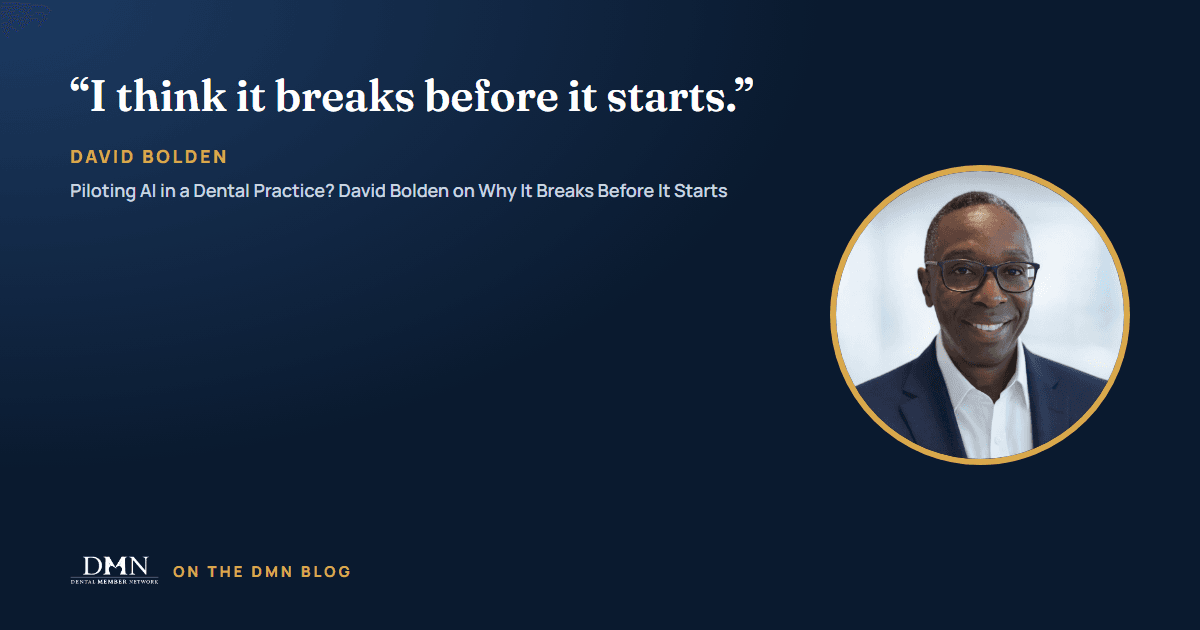
Piloting AI in a dental practice works best when you prepare the workflow and the people before you switch anything on. David Bolden, co-founder of Arise Solutions, puts it in five words: "I think it breaks before it starts." Write down how calls should be routed, how emergencies are handled and how the doctor is told. Name an internal champion. Test for edge cases before going live. Then pick a low-risk first test that adds no work for the team, run it in a few locations, and judge it on patient convenience and financial benefit.
David helps dental groups, multi-location practices and other healthcare organizations put AI to work. On our panel he was asked where AI rollouts break. His answer pointed to the weeks before launch.
Why does AI fail in so many dental practices?
David's view is that AI rarely fails because of the technology. It fails because nobody prepared the work it is meant to do.
When you build the workflow, he says, the AI has to copy what you would want your best team member to do. If the practice has never decided the rules, the AI cannot follow them. The breaks come when nobody has written down how calls should be routed, how emergencies are handled, how the doctor is told and how triage works. "Those are all things that AI is able to do."
Who should own the AI project inside the practice?
David's second cause of failure is a missing owner. "It breaks as well when you don't have an internal champion."
This person needs to see the whole practice and care about the result. "The internal champion has to have that motivation to want it to work." In David's experience, champions often take pride in service levels and keep a close eye on return on investment. Most of all, they give the builders the information needed to set up the workflow properly, whether that is patient intake or outbound calls.
If you have never named one owner for a job in your office, our article on dental team ownership shows how.
How do you know a workflow is ready for AI?
David starts with the people who do the work today. He spends time with the team on "how that workflow works, how they like to work, what is the best outcome for them."
Then he tests it before patients ever hear it. "There should be internal testing. There should be looking for what those edge cases are so that when it is live, it's able to respond in a way that you'd want."
Some of those edge cases are human ones. Callers may be in pain, and "someone may not want to speak to the AI. So you need to be able to have those transfers." Plan the handoff to a real person before you go live.
Which office should you pilot AI in first?
David was asked whether to pilot in the best office or the struggling one. For many groups he leans toward the office with problems. He would start with a location that has known problems "and see how the AI can address that. And if it works for them, then you know it most likely is going to work across your network."
He also keeps the first round small. "I think it's key to maybe start with five locations or four locations." Measure the result on those before you spread it wider.
For a single practice the same idea applies: start with one clear problem you already know about.
What should the first AI test be?
David's team looks at three numbers across a group of practices before choosing. First, "what is the call recovery rate across the different practices?" Second, "what is the utilization rate". Third, "the activation rate", meaning patients who have not been called or cannot practically be called.
From there the owner asks which variable matters most for return on investment, and then "what is that test going to be that is probably the lowest risk". If missed calls are your weak spot, our article on turning new patient calls into appointments covers the human side.
He has one more filter, and he calls it true throughout history. "You also look at something that's not going to add additional work to the team". His reason: "If a tool has more work, you're going to have some degree of resistance internally."
Where can AI take admin work off the team?
David points to work done inside the software your office already uses. AI can now click through a system "as a human would do", he says, and do it overnight.
One example is insurance pre-authorization. After hours, the AI goes through the patient base, finds who would qualify for a procedure that needs pre-authorization, finds the codes and sets it up. A person then reviews it and sends it. His wider rule covers any job where someone is "just spending time inside the PMS or just spending time inside the insurance portal".
The second example is insurance reconciliation: comparing what was requested with what the insurer says it will pay, and flagging the difference for the team to check. Across several locations, he says, "a variance of two percent or three percent or five percent" makes a difference to the bottom line. For the claims that never get paid in the first place, see our guide to preventing dental insurance claim denials.
How do you judge whether the pilot worked?
David uses two tests: convenience for the patient, and "where you're going to have a financial benefit from doing this."
His golden rule is fit. "The AI that is used has to speak to what you require." Otherwise you get "something that's just off the shelf that may do 50% of the work", and the other half can turn the whole thing into a wasted investment.
Frequently asked questions
Why do AI tools fail in dental offices?
David Bolden says it usually breaks before it starts: the call routing, emergency and triage rules were never written down, or nobody inside the practice owns the project.
Should I pilot AI in my best office or my struggling one?
David leans toward a location with known problems. If AI fixes them there, it will most likely work across the network. He suggests starting with four or five locations.
What should a dental practice automate first?
Pick the lowest-risk test with the clearest return, and make sure it adds no extra work for the team. David's team looks at call recovery, chair utilization and reactivation first.
Do patients have to talk to the AI?
No. David says some callers will not want to, so the system needs transfers to a person built in from the start.

About the expert
David Bolden
Co-founder, Arise Solutions
In his own words: "I help healthcare and professional service organizations reduce administrative burden and improve operational performance. My focus is not task automation, but building operational layers that continuously improve how work gets done." David Bolden is the co-founder of Arise Solutions.
The takeaway
Do the groundwork before you buy.
Write down how your calls, emergencies and handoffs should work, name one internal champion, and test the edge cases. Then start small, with a problem you already know. As David says, the AI has to be "reflective of your reality".
Front Desk
It Breaks Before It Starts
David Bolden
Co-founder, Arise Solutions
Continue inside the membership
It Breaks Before It Starts
David Bolden's complete Practice Playbook inside the Dental Member Network, built from his own answers on getting a dental practice ready for AI.
Get David Bolden's It Breaks Before It Starts Practice Playbook inside the Dental Member Network: his action guide, checklist, worksheet and short videos on getting a practice ready for AI.
Join Dental Member Network