The quick answer
To reduce dental front desk overload, identify which essential tasks repeatedly go unfinished, choose one area for dedicated support, and make the handoff clear. Rebecca Herring recommends starting small, often with insurance verification, then comparing the workload before and after. The aim is to give the in-office team more attention for patients, not simply a longer task list.
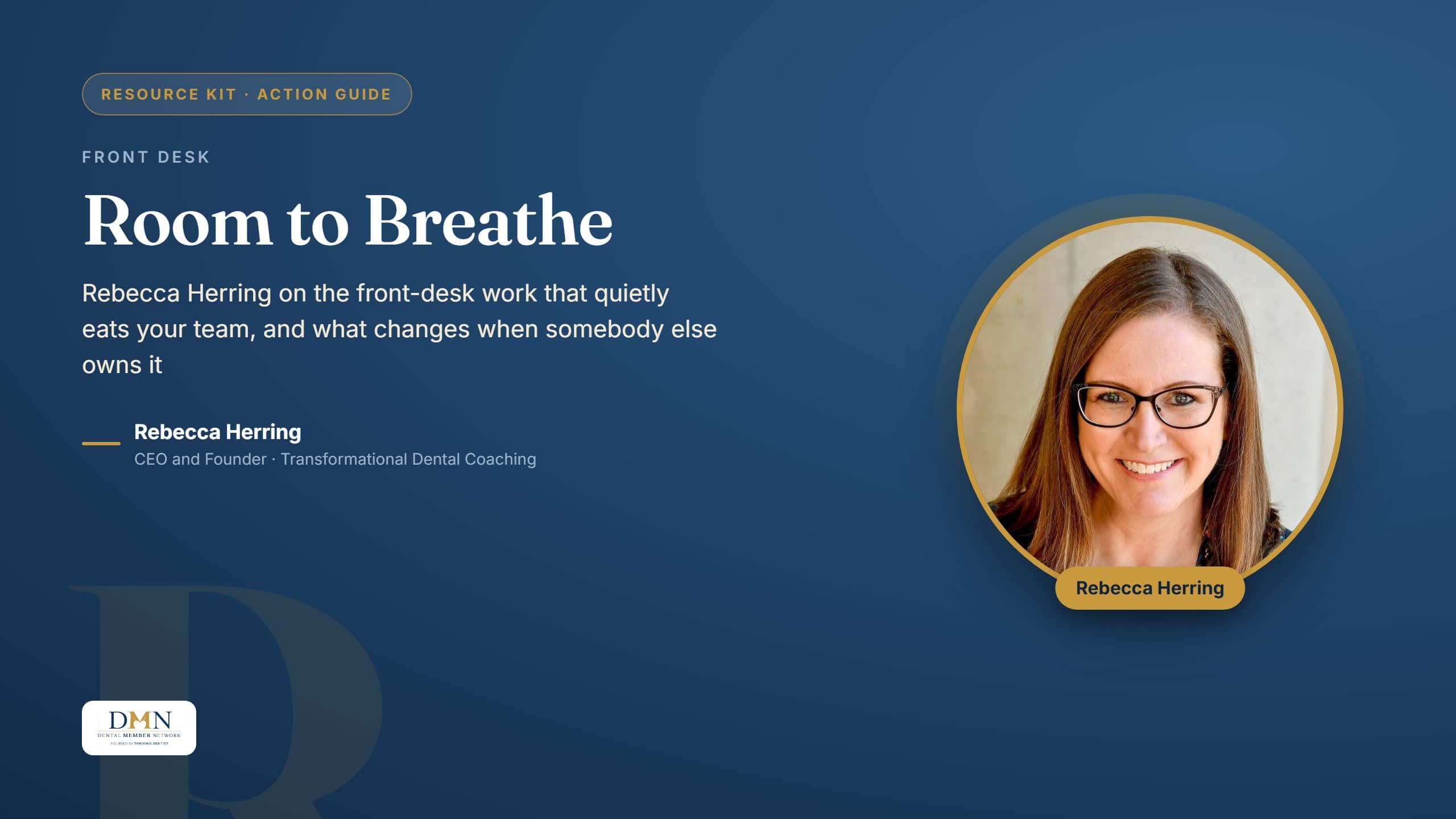
Expert guidance from Rebecca Herring, based on the DMN Practice Playbook, Room to Breathe.
A patient is ready to check out. The phone rings. Someone needs an insurance answer. A cancellation has just opened up tomorrow.
Each request matters. Asking one person to treat all of them as the immediate priority does not make the conflict disappear.
Start with the work that is slipping
Rebecca identifies insurance verification, scheduling, billing, phone support and follow-up as work that can pile up when a practice is overwhelmed.
Before deciding to hire, outsource or buy another tool, look at what did not get finished last week.
Write down the task, who was supposed to handle it, and what interrupted them. Include work that was started but never resolved, such as a patient question passed between several people.
The goal is not to catch someone failing. It is to see where the workload depends on a quiet moment that rarely arrives.
If responsibilities are unclear as well as overloaded, begin with clearer dental-team communication and handoffs. More capacity cannot fix a task nobody understands.
Choose one area for dedicated support
Rebecca's first suggested area is insurance verification and benefit breakdowns. Her reasoning is that incomplete or inaccurate information can create trouble further along the patient and payment process.
That does not mean every office should outsource verification immediately. It means looking carefully at a time-consuming task that has consequences beyond the desk.
Ask whether someone can complete it consistently without also handling the patient standing in front of them. Support could come from a differently allocated in-office role or a suitably trained remote team member.
Rebecca's wider advice is to start with one area and track the effect. You do not need to transfer the entire front desk at once.
Move a complete responsibility, not a vague instruction
“Please help with insurance” leaves plenty of room for misunderstanding.
A practical handoff should explain what information is needed, where it is recorded, what counts as complete, and who handles questions the assigned person cannot resolve.
Those handoff details are an editorial way to make Rebecca's start-small approach usable. Use the practice's approved systems and access arrangements. Moving a task does not remove the need for oversight.
For a closer look at the underlying billing process, see our article on preventing dental insurance claim denials. Here, the focus is giving someone the capacity to carry that process through.
Protect the attention you free up
Rebecca's central point is that the return is not only more completed admin. It is a front desk that can welcome a patient properly and explain a next step without competing demands taking over the conversation.
Do not immediately fill every recovered minute with another assignment.
Ask the team what has become easier. Can they finish a patient conversation? Are promised callbacks happening? Does a question still sit unresolved because nobody has time to investigate it?
A lower task count is useful only if the experience of doing the work improves too.
Watch the unfinished work, not just activity
Sending more messages is not the same as resolving more questions.
Rebecca's worksheet asks practices to identify what is waiting on a callback or insurance answer, how long it has been waiting, and what the patient might conclude from that delay.
You can use that idea for a short review of unresolved work. Record the next action and the person who owns it. Avoid turning it into a public display of patient information.
Also look at cancellations. If the practice expects someone to fill an opening, does that person actually have time to contact suitable patients when it happens?
Compare before and after
Choose a practical measure before moving the first task. Possible measures include unfinished verifications, unresolved callbacks or time the in-office team spends chasing answers.
These are suggested measures, not promised results.
Set a review date. Compare what changed, ask whether the handoff caused extra rework, and decide whether to keep, adjust or expand the arrangement.
Do not judge the change solely by whether the practice looked busier. Rebecca's aim is a more sustainable workload and more attention for patients.
Frequently asked questions
What should an overwhelmed dental front desk delegate first?
Start with the task that repeatedly slips and can be clearly defined. Rebecca suggests insurance verification as one starting point because later patient and payment conversations depend on the information.
Do we have to replace the front desk with a virtual assistant?
No. Rebecca's approach is about supporting the in-office team. Start with one suitable area of work and assess the result before changing anything else.
How do we know whether delegation is helping?
Compare a relevant before-and-after measure, ask the team about interruptions and rework, and check whether patient questions are being resolved more reliably.
The takeaway
Give your team room to breathe.
Find the work that keeps slipping, move one complete responsibility with clear ownership, protect the attention that frees up, and compare a practical measure before and after. The aim is a sustainable workload and a front desk that can give patients its full attention.
Front Desk
Room to Breathe

Rebecca Herring
DAADOM, Transformational Dental Coaching
Continue inside the membership
Get the complete Room to Breathe Practice Playbook.
Available inside Dental Member Network, including the Front Desk Load Worksheet. Use it to identify unfinished work, examine callbacks and cancellations, and choose one area to change first.
Join Dental Member Network