The quick answer
A dental morning huddle should recognize good work, identify one lesson from yesterday, flag today's patient and scheduling needs, and assign any preparation needed for tomorrow. It should finish with clear actions and owners, not simply a readout of appointment times.
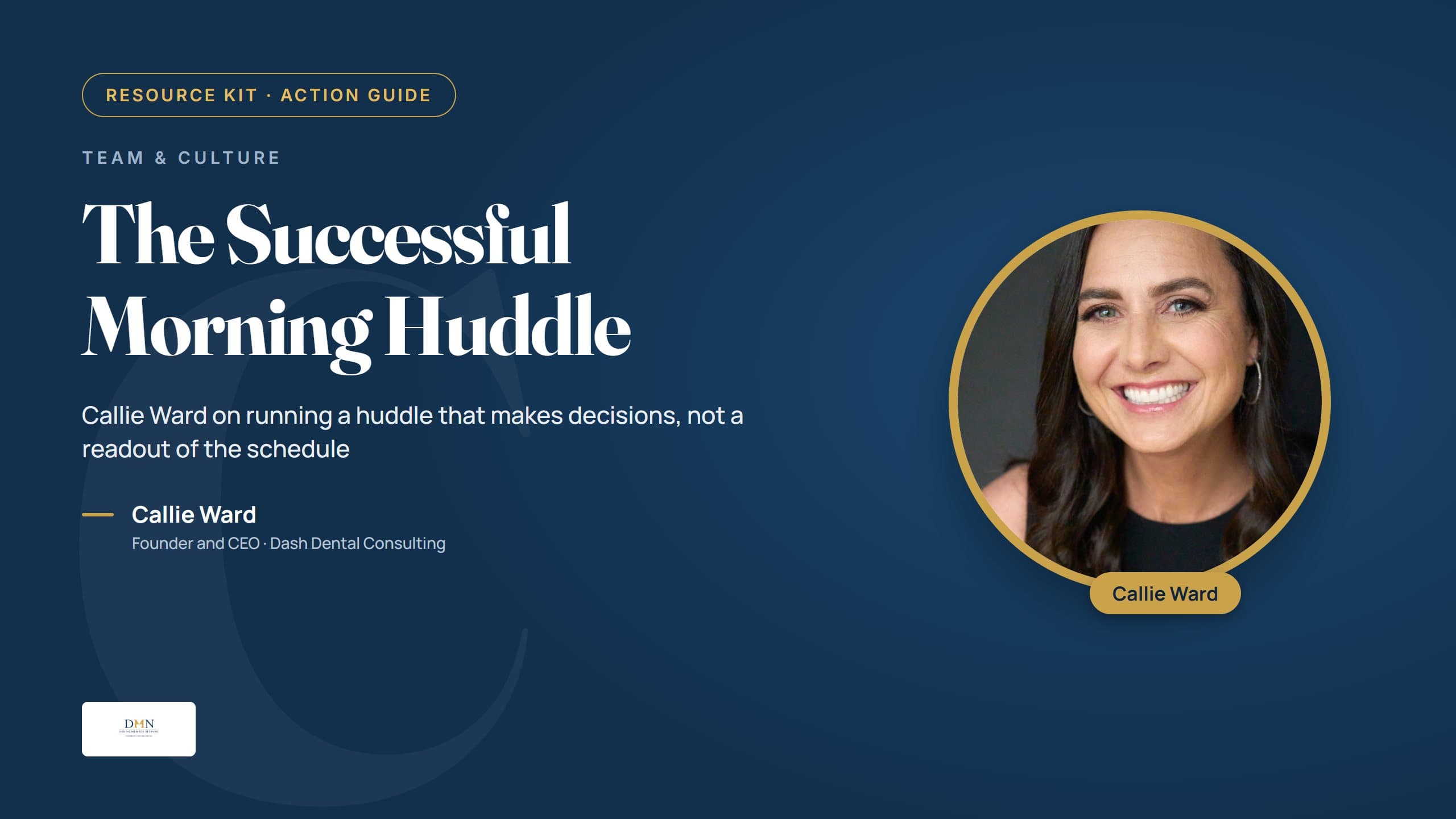
Expert guidance from Callie Ward, Founder and CEO of Dash Dental Consulting, adapted from Successful Morning Huddle.
Callie Ward describes the huddle as the day's positive kickstart and its air traffic control. Her framework combines the tone of the meeting with the practical decisions that help the team prepare.
1. Open with a specific celebration
Start by acknowledging something a team member did well. Callie suggests rotating the huddle leader, with one person leading for a week before handing over.
Make the acknowledgement concrete. “Thank you for explaining the delay to that patient yesterday” gives the team a clearer example than “Great job, everyone.”
This is not a request to pretend yesterday was perfect. It is a way to recognize the work that can disappear into a busy day before discussing what needs attention.
2. Learn from yesterday without blaming a person
Ask where the day became harder than it needed to be.
Did a missing handoff cause confusion? Was there a delay nobody communicated? Did a patient leave with a question that still needs an answer?
Callie's approach is to examine the situation in a non-threatening way. Keep the group conversation on the process and the next action. Do not turn the huddle into a public performance review.
For example, “What information was missing when the appointment changed?” invites a different discussion from “Who messed up the schedule?”
If the issue needs an individual conversation, giving difficult feedback without making it personal offers a separate framework for that discussion.
3. Review a few useful outcomes
Callie's guide includes reviewing production and collections against the measures the practice is already using, checking whether hygiene patients were rescheduled, and identifying follow-up needs.
The purpose is to decide what needs attention, not to recite every number available in the software.
For each item, ask: does this change what somebody needs to do today? If a patient needs a scheduling conversation, name who will follow up. If a recurring issue needs more investigation, assign that work outside the huddle rather than trying to solve everything at once.
4. Look underneath today's appointments
Everyone can read the appointment list. The meeting is useful when it reveals what the list does not explain.
Discuss the preparations and handoffs that matter today:
- Which appointments need extra coordination?
- Where could an urgent appointment fit, subject to the clinician's direction?
- Is any required information, material or laboratory work missing?
- Which patients have an unresolved question or agreed follow-up?
- Who will communicate a delay if the schedule changes?
Callie also recommends reviewing existing unscheduled treatment with the clinician's priorities in mind. A patient conversation should explore what has prevented scheduling, not use the huddle's production goals to pressure the patient.
Clinical decisions stay with the clinician. The huddle organizes the team's response; it does not create blanket treatment or imaging rules.
5. Prepare tomorrow before it arrives
Look beyond the current day's urgency. Callie's framework includes checking upcoming openings, laboratory cases and supplies so that tomorrow's missing item does not become tomorrow's disruption.
End each issue with an owner and a next step. “Check the lab case” is less useful than knowing who will check it and when the result needs to reach the team.
The time you save is not something to assume or promise. Watch whether fewer unresolved preparation questions reach the start of the next day.
A simple agenda you can use tomorrow
This is an editorial adaptation of Callie's framework, not a separate worksheet from her kit:
- Recognize: What did someone do well?
- Learn: What happened yesterday that needs a process improvement?
- Act: Which results require a follow-up today?
- Prepare: What needs attention underneath today's schedule?
- Look ahead: What must be ready for tomorrow?
- Confirm: Who owns each action?
Keep longer problem-solving discussions outside this meeting. A focused huddle can surface an issue without consuming the time needed to resolve it.
For habits beyond the daily meeting, read how to improve communication in your dental practice.
Turn the agenda into a routine
Try the agenda with your team, then ask what helped them prepare and what was merely repeated information. Keep the parts that lead to clearer decisions.
The takeaway
A huddle is for decisions, not a readout.
Recognize one thing done well, learn one lesson from yesterday, decide which results need action today, look underneath the appointment list, and get tomorrow ready. End every item with an owner and a next step.
Team & Culture
Successful Morning Huddle

Callie Ward
Founder and CEO, Dash Dental Consulting
Continue inside the membership
Get the complete Successful Morning Huddle Practice Playbook.
Available inside Dental Member Network, including the morning huddle worksheet.
Get the complete Successful Morning Huddle Practice Playbook inside Dental Member Network, including the morning huddle worksheet.
Join Dental Member Network