The quick answer
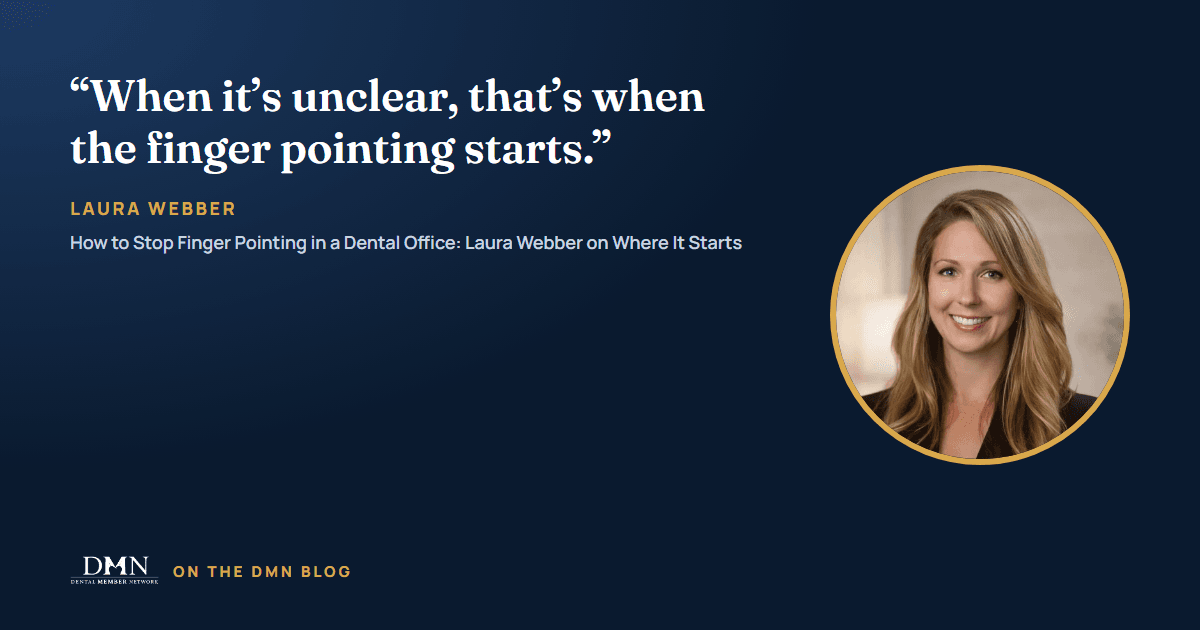
Finger pointing in a dental office starts when roles are unclear and the team is not talking. Laura Webber, founder of LW Excellence in Dental Management, fixes it with two expectations: every task has one owner, and communication has a structure, starting with a short huddle every morning. In her words: "When it's unclear, that's when the finger pointing starts."
Laura spent twenty years managing a busy fee-for-service practice before she began coaching other teams. She says she has had accountability conversations hundreds of times, and the pattern is familiar. Something goes wrong in the afternoon, and by the end of the day everyone is sure it was someone else's job.
Her view is that blame shows up when people do not know who owns what.
Where does finger pointing in a dental office come from?
Laura's example is the schedule. Two team members each think the other one is handling something. One thinks a colleague was filling the open spots. The other thought the first was going to tell the doctor about the emergency. Nobody did either.
Teams need to know what the roles are and what the expectations are of them so that they can perform and they can be confident in the roles.
Who should own the schedule?
This is the first expectation Laura sets: own your role, and better still, own your task. She starts with the question most practices have never answered out loud. Who is in charge of the schedule?
Every practice needs absolute clarity for this.
She is careful about what that means. "And this isn't somebody that's answering the phone." In many offices, two, three or more people answer the phone. The schedule owner is one named person. In Laura's words, "This is somebody who is responsible for making sure the schedule is full, that emergencies are handled," that the clinical team hears about them, and that the practice's own protocols are followed.
Write that name down, then do the same for other tasks that fall between chairs.
How does communication stop the blame?
Laura's second expectation is communication. She calls herself huge on it. "I can't stress it enough."
If you are not talking to your team, you cannot tell them what you expect. She suggests finding the channel that works for your team: the morning huddle, the patient handoff, or messages through the practice software.
In her words, "I think without some sort of structure and without that kind of communications, things fall through the cracks and then people assume someone else handled it and then there enters the finger pointing."
Our article on improving dental team communication has more ideas on making the handoffs stick.
Why does a morning huddle help so much?
If Laura could pick one habit for every practice, it would be the morning huddle. It does not need to be long. Ten or fifteen minutes before patients arrive and before the phones start ringing is enough.
It'll prevent most of the problems that show up later in the day.
The team talks about the schedule, the goals and the plan for the day. When a team does this every morning, she says, "that's when the accountability stops being something that is being forced. And it just happens naturally."
If you want a starting agenda, see our guide to a dental morning huddle agenda.
What should you say when something still goes wrong?
When something still slips, Laura's advice is to have the conversation anyway. In her words, "you're not doing anybody a favor by not having these conversations."
The trap is making it personal. "The mistake a lot of people make is turning it into a personal conversation," she says, with questions like why did you do this, or why didn't you do it the way we talked about. That kind of question puts people on the defensive straight away.
Instead, she says, "you have to take that personal piece out." Keep the talk on the expectation and on the problem. Then ask. "Ask them where they went wrong or what went wrong, what got in the way."
Laura finds the answer is usually confusion about the role, too little time, or too little support. Each one is something the practice can fix.
For more on the conversation itself, read Julie Parker on having a difficult conversation with a dental employee.
How do you keep people from hiding mistakes?
A team that is afraid of blame stops reporting problems. Laura used to tell her team to come to her with anything. "We can always fix the problem. But if I don't know that there's a problem, I can't fix it."
That needs what she calls a judgment free zone, whether someone is just having a day or has made a big mistake. And it starts with the leader admitting the same thing. "We all make mistakes."
She also puts real weight on noticing good work. "Celebrating the wins are everything," she says. Most people try harder when they know their effort will be seen.
What about a high performer who will not follow the system?
Every practice has one. Laura's answer is to separate the skill from the behavior. Being great at the job "doesn't excuse them from their behavior basically."
She does not go in hot. She starts with what is true: "hey, you know how much I value you." Then she names the standard: "we need to focus on these standards that we've set," and explains why it matters. A high performer who follows the system brings the rest of the team along.
Frequently asked questions
What causes finger pointing in a dental office?
In Laura Webber's experience, it starts when roles are unclear and communication has no structure. Team members assume someone else handled a task, and when it falls through, the blame starts.
Should one person own the dental schedule?
Laura says yes. Several people may answer the phone, but one named person should be responsible for keeping the schedule full, handling emergencies and telling the clinical team.
How long should a dental morning huddle be?
Laura suggests about ten to fifteen minutes, every morning, before patients arrive. Short is fine. Doing it every day is what counts.
How do you correct a team member without blame?
Keep it about the expectation and the problem. Ask what got in the way. Laura finds it is usually unclear roles, too little time, or too little support.

About the expert
Laura Webber
Founder, LW Excellence in Dental Management
My expertise in dental management, team coaching, and private practice development allows me to enhance the efficiency and success of your dental practice. With over 20 years of experience in managing a multi-million dollar FFS practice, I understand the unique challenges faced by dental professionals and offer tailored solutions to meet your specific needs. I've spent my career helping dentists and their teams turn daily challenges into streamlined systems and stress into growth. From front desk flow to back office efficiency, financial health to team culture, I've seen it all. Lately, I've become especially passionate about team connection and culture. Small, intentional acts of recognition and celebration can transform the energy in an office. I love helping teams reconnect, celebrate wins, and rediscover the joy in their work.
The takeaway
Put a name on every task, then talk about it every morning.
This week, write down who owns the schedule in your practice. Tell the team. Then start tomorrow with a ten minute huddle. As Laura puts it, "communication is everything."
Team & Culture
Where the Finger Pointing Stops
Laura Webber
Founder, LW Excellence in Dental Management
Continue inside the membership
Where the Finger Pointing Stops
Laura Webber's complete Practice Playbook inside the Dental Member Network: the morning huddle, one name on the schedule, and the accountability conversation, with a checklist and worksheet your team can use on Monday.
Get Laura Webber's Where the Finger Pointing Stops Practice Playbook inside the Dental Member Network, with her short videos, the checklist and the worksheet for your next team meeting.
Join Dental Member Network