New-patient numbers can look encouraging while treatment acceptance quietly stalls. If patients are calling, booking, and arriving, but recommended care is not being scheduled, the practice has not solved its growth problem. It has simply moved the problem further along the patient journey.
The better question is not only, “How many new patients did we get?” It is, “How reliably do we help the right patients understand, value, and schedule the care they need?”
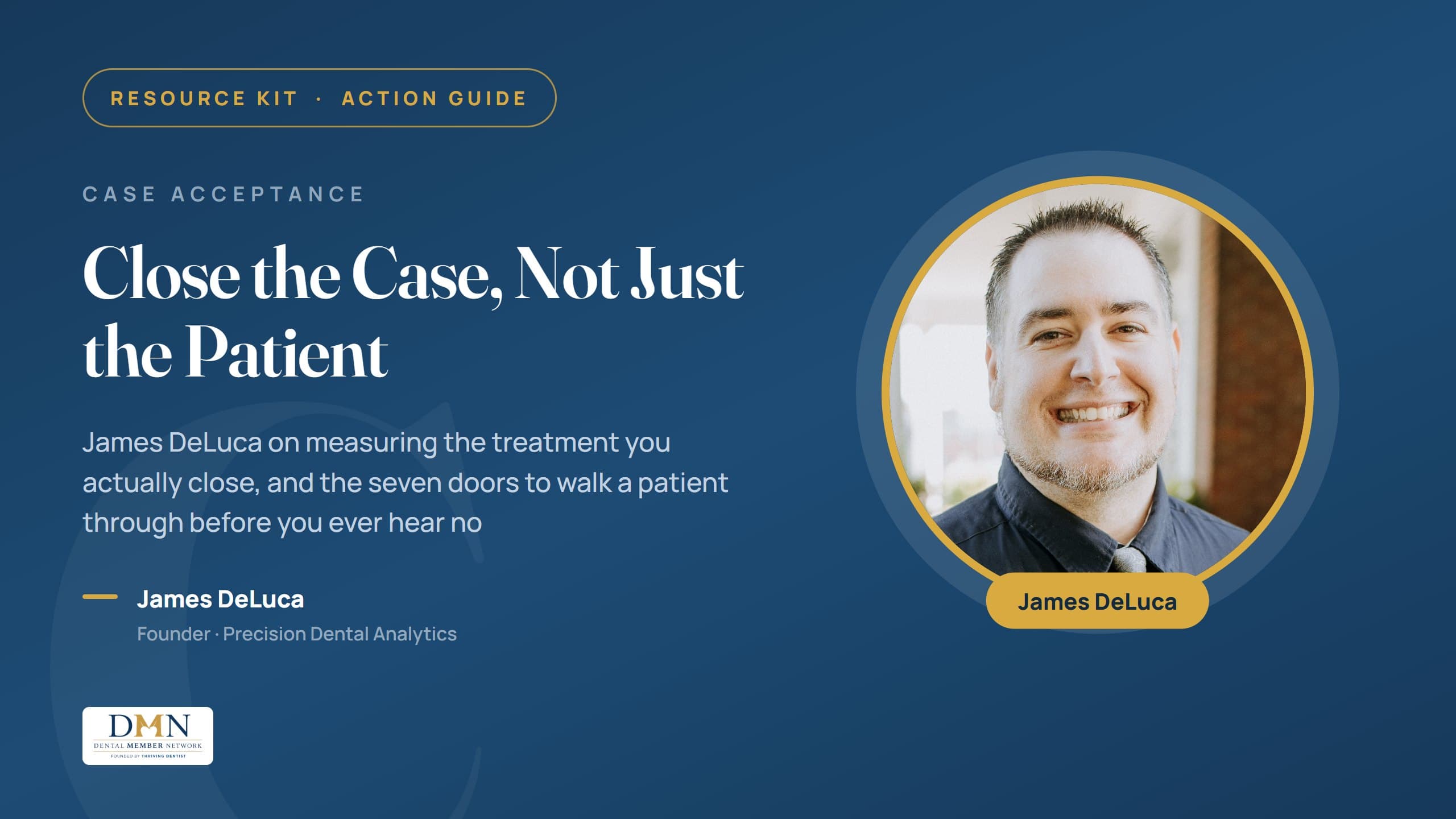
James DeLuca's Close the Case, Not Just the Patient Playbook focuses on this distinction. It gives owners and teams a way to look beyond arrivals and improve the system that turns a diagnosis into an informed patient decision.
New-patient growth is only the first door
Attracting a new patient matters. But it is an early step, not the outcome. A patient can be delighted with the front desk, enjoy a friendly appointment, and still leave without moving forward on recommended treatment.
When this happens repeatedly, leaders often react by asking for more leads, more calls, or more marketing. Those initiatives may increase activity, but they do not repair the moment where value is lost.
Instead, separate these measures:
- New patients acquired
- Patients diagnosed with a treatment need
- Treatment presented
- Treatment scheduled
- Treatment started and completed
The gap between those measures is where the case-acceptance system needs attention.
Why patients do not move forward
A patient saying “I need to think about it” is not automatically an objection to overcome. It can mean the patient does not yet understand the problem, does not see why timing matters, does not feel confident about the solution, or has not been given a practical next step.
That is why the strongest case-acceptance process is not a pressure script. It is a patient-centered communication system. The team makes the clinical recommendation clear, connects it to the patient's own goals, answers questions honestly, and makes the next decision easy to understand.
Use the seven-door mindset
In Close the Case, Not Just the Patient, James uses a Seven Doors framework to help teams examine the decision path rather than blaming one conversation or one team member.
The useful leadership question is: where does the patient journey stop moving?
For example:
- Is the diagnosis clear in plain language?
- Did the patient have enough time to ask questions?
- Was the recommended care connected to the patient’s own priorities?
- Did the conversation include a specific next step?
- Did the team handle financial options clearly and respectfully?
- Was the patient given a reason to act now, without fear or pressure?
- Is there a follow-up process for patients who leave undecided?
Each answer points to a system issue that can be coached, measured, and improved.
Make treatment value a visible practice metric
Most practices already track activity: calls, new patients, production, and collections. James's framework adds a more revealing conversation: how much diagnosed treatment is being understood and accepted by patients?
Choose a simple measurement your team can review consistently. The exact calculation should match your software and workflow, but the purpose is the same: make the distance between presented treatment and scheduled treatment visible.
Review it alongside new-patient volume. If new patients rise but scheduled treatment does not, the practice has a clear signal that marketing is not the first issue to solve.
Build a calmer, more useful treatment conversation
Good case acceptance begins before the financial conversation. It starts with listening.
When a patient describes discomfort, appearance concerns, a future event, or a desire to keep their teeth healthy, capture those words. During the recommendation, connect the clinical finding back to what the patient said matters to them.
Then keep the conversation practical:
- Explain the finding in plain language.
- Show the patient what you are seeing when visual tools are available.
- Explain the consequence of waiting without exaggeration.
- Present the recommended path clearly.
- Ask what questions the patient has.
- Discuss appropriate payment or financing options transparently.
- Agree on the next step before the patient leaves.
This approach respects patient choice. It also gives the team a repeatable structure that does not depend on one naturally persuasive person.
Follow up with purpose
Not every patient will decide on the day of the visit. That is normal. What matters is whether the practice has a consistent, useful follow-up process.
Follow up should refer to the patient’s stated concern, restate the recommended next step, make it easy to ask questions, and offer a clear scheduling route. Avoid generic reminders that feel automated or transactional.
The goal is not to chase a patient into saying yes. The goal is to make sure an informed patient can act when they are ready.
What to discuss in the next team meeting
Start small. Ask the team to identify one point in the treatment path that feels inconsistent. It may be how treatment is explained, when financial options are introduced, who owns follow-up, or how results are tracked.
Improve one part, review the result, and then move to the next. Consistent execution will teach the practice more than a one-time motivational push.
The bottom line
New patients are valuable, but they are not the finish line.
A sustainable practice helps patients understand the care they need, see its relevance to their goals, and take the next step with confidence.
Case Acceptance
Close the Case, Not Just the Patient

James DeLuca
Founder, Precision Dental Analytics
Continue inside the membership
Get the complete Close the Case, Not Just the Patient Practice Playbook.
The member Playbook gives owners and teams a way to look beyond arrivals and improve the system that turns a diagnosis into an informed patient decision.
Start Your 3 Months Free