The quick answer
When dental staff are not following new procedures, Greg Essenmacher, CEO and founder of GnA Consulting, starts with the person who asked for the change. Before you ask an employee why they are not doing it, ask yourself whether you have clearly explained "the why behind the what". Then check whether you are facing a will problem or a skill problem, show people what good looks like, and give them a reason that matters to them. As Greg puts it, if they don't understand the why behind it, "then it's simply another thing for them to do. And they won't adopt it."
Greg works with treatment coordinators, front desk teams and practice owners across the country. On our panel he kept coming back to one idea: people follow a new procedure when they understand why it exists.
What should you do first when the team won't follow a new procedure?
Greg's advice is something you can do on Monday morning. "Pick one thing where you get non-compliance, right?" It might be a rule or a tracker where you find yourself thinking, people just aren't following this.
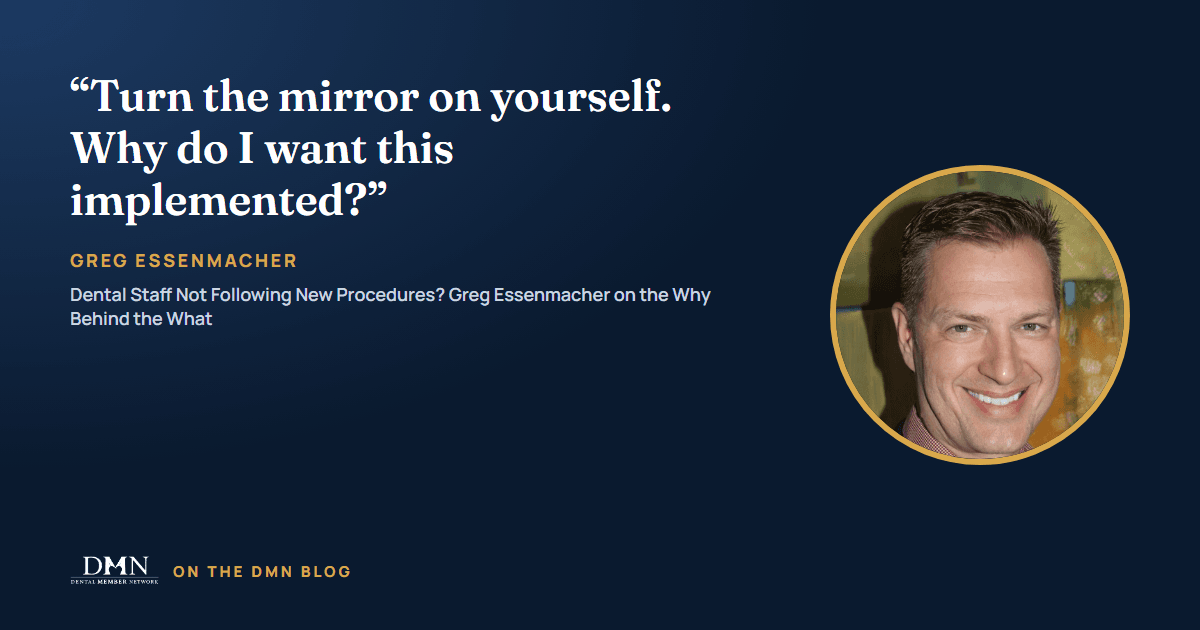
Then, instead of going to the employee, look at yourself. "Rather than going to the employee and asking them, why aren't you doing this? Turn the mirror on yourself. Why do I want this implemented?"
He asks owners to check whether they have explained why it matters to them, and then: "Why is it important to the success of the group? And what does everybody get out of it?"
Sometimes the check shows there is a better way. Sometimes it shows the job simply has to be done. His example is the bathroom: "nobody likes cleaning the bathroom but if the bathroom isn't clean and folks go in there, our case acceptance is gonna go down."
Is it a will problem or a skill problem?
When someone falls short of a standard, Greg reminds owners that "sometimes we forget the human behind it." His question: "is it a will problem? Or is it a skill problem?"
If the person is willing but missing the skill, the fix is training, delivered in a way they can take in. Greg warns against assuming that a sent document counts as training. "By simply stating, oh, we sent over an SOP on that, we sent over the playbook. Didn't you receive it in your email or a click through online learning platform? Perhaps that's not their learning style."
He describes three learning styles: kinesthetic (learning by touch and feel), auditory and visual. His advice is to teach in more than one way. "It doesn't mean that your message has to change, but your messaging has to change so that they receive the message better."
The standard stays the same for everyone. "Instead of managing to the age, it's really managing your standard." If you need help writing the standard down, our article on dental practice SOPs covers how. And if the person has the skill and still is not doing it, our guide to having a difficult conversation with a dental employee can help.
Why does the team need to know "what good looks like"?
Greg sees new procedures fail when people cannot tell whether they are doing well. "For most human beings, they just want to know what does good look like."
His answer is a set of benchmarks over the first 30, 60 and 90 days. Measure where someone is now, show them the target, and give them the tools and training to get there. "So that people have a clear path, a clear vision of where are we now? Where are we trying to get to? And then how are we going to help you achieve that?"
Leaders often skip this step because the plan is already clear to them. "We know what the vision is because we've been talking about it for three or six months prior to the acquisition or to the big change. But this is all brand new, right?"
What happens when people don't hear the why?
Greg's warning is simple. "When we don't have information, what do we do? We fill in the gap. And it's usually not with positive intent."
That gap fills with rumors. "I guarantee that there's a group chat going on that nobody knows about." Before long, people leave, or they never start the new procedure at all because they feel overwhelmed.
This is where the why behind the what matters most. In Greg's words: "The what is the tool? If they don't understand the why behind it, then it's simply another thing for them to do." Good daily communication helps close the gap. See our article on improving dental team communication for more.
How do you give each person a reason to care?
People want to know the change is worth it. "People wanna make sure their jobs are secure." They want to enjoy their work, and they do not want more of it. Greg sums it up as "What's in it for me?"
He names three motivators. Money is one, and "if you throw money at somebody that's not motivated by money, it won't land." Recognition is another, such as "a simple thank you, or publicly recognizing them in a morning huddle or in front of the team or group." The third is accountability. "There are some people that literally get jazzed if you hold them accountable and they perform for you."
His point is to learn which one drives each person. "Some people have more than one, but one is always dominant."
He has seen what happens when people cannot connect their work to the result. Working with a large group, his team asked 37 office managers and treatment coordinators how improving something today would affect their monthly bonus. "And out of 37 of them, one could give us an answer." For Greg, that told them "they really don't understand and they don't know what their personal impact is."
Frequently asked questions
Why won't my dental team follow a new procedure?
Greg Essenmacher says it is often because nobody explained the why behind the what. Without the why, a new tool is "simply another thing for them to do."
Should I talk to the employee first?
Greg suggests looking at yourself first. Ask why you want the procedure, whether you explained why it matters to you and the group, and what everybody gets out of it.
How do I tell a will problem from a skill problem?
A skill problem means the person is willing but has not learned how. Greg's fix is training in the way they learn best. A will problem needs a different conversation.
What motivates dental team members to follow through?
Greg names three motivators: money, recognition and accountability. Most people have one that is dominant, so find out which one drives each person.

About the expert
Greg Essenmacher
CEO and Founder, GnA Consulting
Greg Essenmacher is a dental industry professional and leadership-focused speaker, and the CEO and founder of GnA Consulting. He helps practices strengthen team performance, communication and operational culture, and supports dental leaders through workforce challenges including retention, burnout, accountability and changing team expectations. He brings a practical, people-first perspective to building stronger teams, so owners create practices where employees feel supported, engaged and motivated to stay.
The takeaway
Explain the why behind the what.
Pick the one procedure your team skips most. Before you ask anyone why, write down why it matters to you, to the practice and to them, and share it. As Greg says, "accountability is a gift to your team and that includes yourself."
Team & Culture
The Why Behind the What
Greg Essenmacher
CEO and Founder, GnA Consulting
Continue inside the membership
The Why Behind the What
Greg Essenmacher's complete Practice Playbook inside the Dental Member Network, built from his own answers on will versus skill, what good looks like and the three motivators.
Get Greg Essenmacher's The Why Behind the What Practice Playbook inside the Dental Member Network: his action guide, checklist, worksheet and short videos on will versus skill, what good looks like and the three motivators.
Join Dental Member Network