The quick answer
The dental practice reports to check, according to Janice Janssen, RDH, CFE, co-founder of Global Team Solutions, follow a simple rhythm. Daily, look at the day sheet from your practice management software. Weekly, run the audit trail and glance at your insurance and aging reports. Monthly, balance your bank statement and your merchant services statement against your software. The reports only help if you read them and ask about what you see. In her words, "the important part is to look at those things and know what you're seeing."
Janice goes into dental offices as a consultant, and she opened her answer on our panel with one line: "I'm really big on reports." Here is her routine, step by step, and the habits that make it work.
Which report should a dentist check every day?
Start with the day sheet. "There should be a day sheet that's run" each day, Janice says, and either saved as a PDF and sent to the doctor or owner, or printed and kept somewhere. What she warns against is a report "thrown on a shelf and the team knows that you never look at it."
Then ask about what you see. "And I always tell people to ask questions." Her examples are everyday ones: "why didn't he pay today?" or "what is this adjustment for on the next patient?" Asking, she says, "shows that you're aware and you're paying attention."
She adds a second daily habit to her written protocols: "balancing your deposits at the end of the day, as well as balancing your procedures." That means checking the appointment book, "making sure everybody was charged and they were charged correctly." A lot of the time the misses are innocent, she says: "it's just because we get busy." The daily balance catches those honest slips too.
What should you review every week?
Janice runs an audit trail weekly. "If you do those weekly, it's not overwhelming." Leave it for a month or six months and "then it's too much data to look through."
In the audit trail, "you can see if there's deletions or changes," and you ask about anything you do not understand.
Look at your insurance reports and aging reports weekly too. "You just need to give yourself 10 minutes." Once you know what you are looking for, she says, it goes quickly. And check that patient statements are actually being sent: "make sure that they're going out."
What is the big monthly check?
For Janice, "the big thing monthly is balancing your bank statement and your credit card, your merchant services statement." Make sure those match what your practice management software shows. She does not expect a perfect match every month, but it should be very close, and it catches up down the line.
Her tip is to keep a simple spreadsheet. Put the numbers in each month, and over time you can answer one question: "am I continually low in my bank or did it make up the next month?"
For more on reading the monthly numbers, see our article on dental practice cash versus profit.
Who should handle the money?
Reports work best when the duties are split. "You've got to separate the duties," Janice says. "Don't have the same person that is entering the checks, the one that is taking them to the bank."
She is firm about one job in particular: "the owner should always take the deposits to the bank."
She wants every protocol written down, including the password policy. Everybody has their own password, and she tells teams: "don't share your password with your friend because guess what? Your friend could be the one that's stealing."
Adjustments and refunds get the same care. In her offices, anyone who puts an adjustment on the ledger adds a note and their initials, so whoever looks at it later knows why it is there. "Just saying credit adjustment doesn't mean anything to me."
Our guide to dental practice SOPs shows how to write these down. Then, Janice says, "review those protocols annually" to make sure they still work.
Does checking reports mean you don't trust your team?
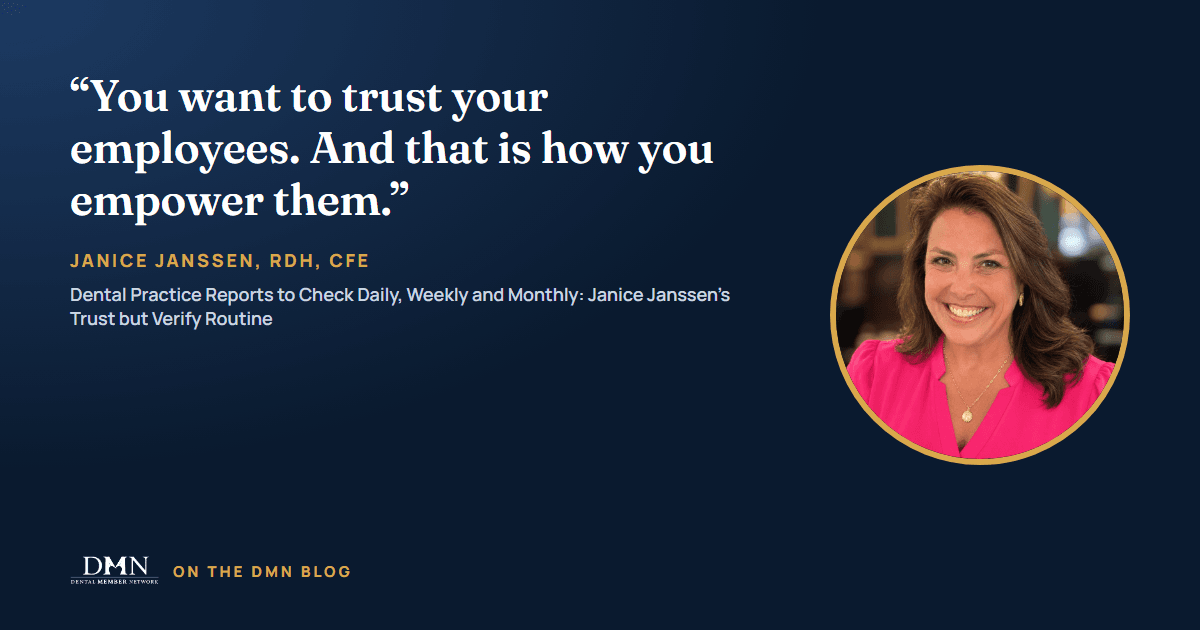
Janice's answer is the saying she quoted on our panel: trust but verify. "You want to trust your employees. And that is how you empower them." She then adds the other half. You run the reports, "ask the questions, know your business so that you can understand if there's something that's not looking right."
It starts with clear roles. "For me, it's all about accountability." People know their duties, and "everything should be written out so that we know what is expected." She says that makes people more confident in their work.
Culture matters as much as the reports. Janice says, "most fraud, most embezzlements are caught by another person." It might be a patient, or "it could be from another employee." That only works when people feel safe speaking up. "You have to create that culture that people are going to feel like they can come to you." Our article on building team ownership in a dental practice, from her Global Team Solutions co-founder Denise Ciardello, goes deeper on that side.
Frequently asked questions
What reports should a dentist look at every day?
Janice Janssen starts with the day sheet from the practice management software, sent to the owner as a PDF or printed. She also has the team balance deposits and procedures at the end of each day.
How often should you run an audit trail in a dental office?
Weekly. Janice says that weekly keeps it from being overwhelming, while a month or more of changes is too much data to look through.
Should the owner take the deposits to the bank?
Yes. Janice says the owner should always take the deposits to the bank, and the person entering the checks should not be the one taking them there.
How long does the weekly check take?
Janice says about 10 minutes for the insurance and aging reports once you know what you are looking for.

About the expert
Janice Janssen, RDH, CFE
Co-Founder, Global Team Solutions
At age 14, Janice Janssen got an after-school job working for her dentist. Little did she know how that choice would determine the course of her future. Twenty-something years later, she is the co-founder of Global Team Solutions and an expert in dental practice consulting. Since her introduction into the field as a teen, she has enjoyed a long career as a dental hygienist and served and excelled in many other roles including office management, insurance billing, and collections. Now Janice enjoys consulting because it allows her to share her techniques with the doctors, hygienists, and office staff who are on the front line every day. She is co-author of OMG! Office Management Guide, the "bible" used in GTS training workshops. She is a member and former Treasurer of the Academy of Dental Management Consultants (ADMC), and is a Certified Fraud Examiner (CFE), which positions her as an expert in educating dentists to deter fraud and embezzlement in their practice.
The takeaway
Trust your team, and verify with the reports.
Tomorrow, read your day sheet and ask one question about something on it. This week, give the audit trail 10 minutes. At month end, put your bank and merchant statements next to your software. As Janice says, "you can only do so much," so build each layer in.
Billing & Collections
Trust but Verify
Janice Janssen, RDH, CFE
Co-Founder, Global Team Solutions
Continue inside the membership
Trust but Verify
Janice Janssen's complete Practice Playbook inside the Dental Member Network, built from her own answers on the reports to run, the questions to ask and the money protocols to write down.
Get Janice Janssen's Trust but Verify Practice Playbook inside the Dental Member Network: her action guide, checklist, worksheet, team huddle and short videos on the reports to run, the questions to ask and the protocols to write down. Members also get her SOP, The money check, daily, weekly, monthly.
Join Dental Member Network